Promotion of Academic Research, Science and Technology
The Hitachi Global Foundation Asia Innovation Award Program Review
Promotion of Academic Research, Science and Technology
The Hitachi Global Foundation
Asia Innovation Award Program Review
1. Introduction
The Hitachi Global Foundation Asia Innovation Award was established to support science and technology innovations that contribute to solving societal issues and realizing a sustainable society in the ASEAN region. Since its inception in FY2020, the program has supported efforts to bring research outcomes to society.
Over the first five years, submissions have become more diverse and higher in quality, and academic and technological initiatives grounded in local contexts have steadily expanded. Encounters and outcomes catalyzed by the Award have deepened understanding of societal issues and opened new possibilities for social implementation, reaffirming both the potential of the ASEAN region and the strength of researchers who are shaping its future.
At the same time, day‑to‑day operations and selection processes have revealed several areas for improvement and emerging challenges. Marking this five‑year milestone, the present review summarizes achievements to date alongside outstanding issues, with the aim of informing the program’s continued development.
Achieving a sustainable society today requires broader collaboration and practical application of knowledge. Delivering the benefits of science and technology to society calls for cooperation across countries and disciplines, as well as the accumulation of knowledge rooted in local realities. The Award will continue to serve as a platform that supports researchers undertaking these challenges.
We extend our sincere appreciation to everyone who has supported the program thus far, and we hope this review offers readers an opportunity to recognize the value of research that shapes the region’s future.
2. Purpose and Background of the Program
The Hitachi Global Foundation Asia Innovation Award was launched in FY2020 to recognize researchers in the ASEAN region who are working to address societal issues. The program builds on the legacy of the Hitachi Scholarship Program, which the Foundation operated for 35 years beginning in 1984. Through that initiative, 460 researchers from six countries were invited to Japan, creating a strong foundation for academic exchange and human resource development. As the Scholarship Program reached a mature stage, the Foundation shifted its focus from supporting researchers through overseas invitations to recognizing and encouraging innovation initiated by researchers in their local environments.
In 2015, the United Nations adopted the Sustainable Development Goals (SDGs), setting global priorities for addressing urgent societal challenges. In the ASEAN region—where the population is large and issues related to urbanization, the environment, and energy continue to grow in complexity—research and its application play an increasingly important role.
Against this background, the Award seeks to highlight the achievements of ASEAN researchers who are tackling societal issues and to share their contributions widely. A defining feature of the program is its evaluation framework, which emphasizes not only academic excellence but also the potential for social implementation.
3. Program Evaluation
3-1. Process Evaluation
3-1-1 Ensuring Transparency and Fairness
The Award has consistently emphasized a fair and transparent evaluation process. In addition to contribution to particular SDG goals and targets designated each year, research originality, societal significance, evidence‑based validation, and the potential for social implementation have been systematically assessed using clearly defined criteria.
The involvement of external experts with relevant academic and professional backgrounds ensures both expertise and third‑party neutrality. At each stage of the process—document screening, the first selection committee meeting, online interviews for Best Innovation Award candidates, and the second selection committee meeting (final decision)—evaluations and comments are shared among committee members. Decisions are made through deliberation to secure fairness and well‑grounded assessments.
3-1-2 Program Implementation Structure
The program operates under the following structure:
- Secretariat: Handles administrative tasks such as application management, selection operations, external coordination, and award notifications.
- Selection Committee: Conducts document screening, selects interview candidates, evaluates interviews, and makes final decisions.
- Working Group: Provides specialized advice in necessary fields, complementing the Secretariat and Selection Committee.
This structure ensures stable and flexible program operations while maintaining both expertise and continuity.
3-1-3 Improvements to the Implementation Process (2020–2024)
During the establishment phase (FY2020–FY2024), no major structural changes were made to the program. However, a series of gradual improvements were introduced to enhance applicant support and strengthen the quality of the selection process:
- Development and Distribution of FAQs: A detailed “Frequently Asked Questions” document was created to help universities and applicants understand the procedures and requirements. It clarified supplementary information related to the application guidelines, instructions for completing forms, and the selection process. This improved both efficiency in handling inquiries and applicants’ convenience.
- Application Form Improvements: Sections related to social implementation were revised, and new fields were added to explain competitive advantages and research originality. Requirements for the length of attachments were clarified, improving fairness and efficiency.
- Digitization of Review Materials: Review materials were provided in digital form, helping reduce printing volume. Even for selection committee members who preferred to review documents on paper, the digital format enabled quick access to materials while traveling, allowing for a more flexible review environment.
These incremental improvements enhanced accessibility for applicants and usability for reviewers, contributing to greater transparency and quality in program operations.
3-2. Outcome Evaluation
This section summarizes the outcomes of the Award during FY2020–FY2024 based on quantitative indicators (outputs) and qualitative/impact indicators (outcomes). Because the program does not operate through an open call, applications are accepted only from universities and research institutions designated by the Foundation. During FY2020–FY2024, two SDG goals and several targets were designated each year. These operational conditions influence applicant pools and thematic scope, serving as essential context for interpreting the indicators and subsequent analysis.
3-2-1 Outputs (Quantitative Indicators)
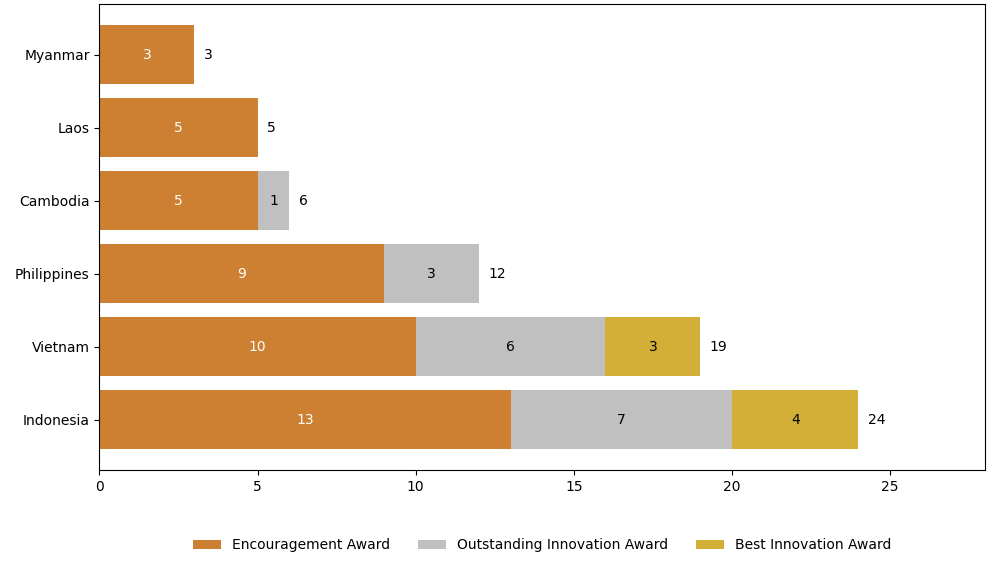
Over the five years from FY2020 to FY2024, the Award covered six countries and 41 institutions, recognizing a total of 69 achievements (7 Best Innovation Awards, 18 Outstanding Innovation Awards, and 44 Encouragement Awards). Annual award numbers ranged between 12 and 16, with limited year‑to‑year variation. By country, Indonesia had the highest number of award recipients, followed by Vietnam and the Philippines. Best Innovation Awards were primarily concentrated in Indonesia and Vietnam. (Figures 1 and 2)
Figure1: Trend in Number of Awards (FY2020-FY2024)
Figure1 View on another screen
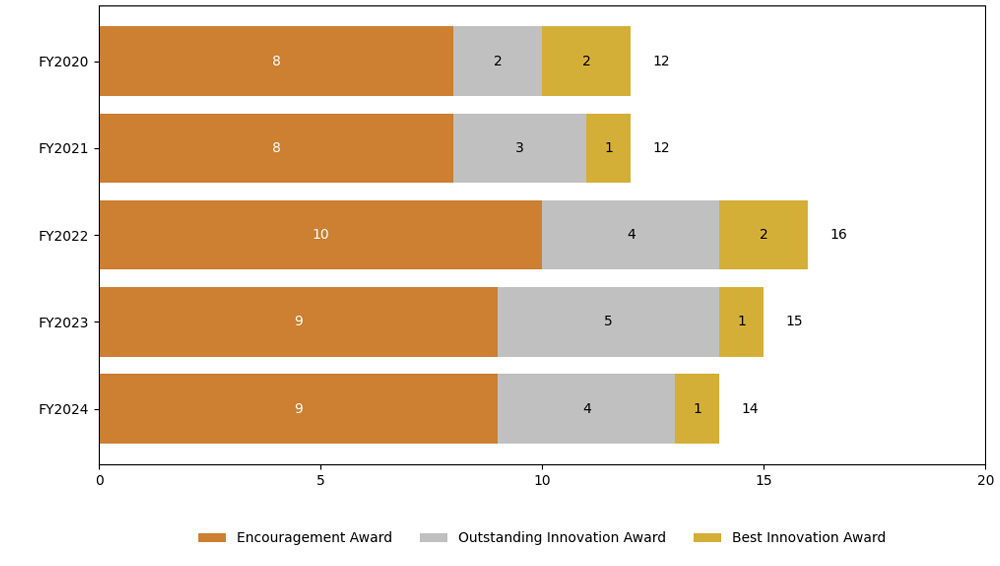
Figure2: Number of Award Recipients by Country (FY2020-FY2024)
Figure2 View on another screen
3-2-2 Outcomes (Qualitative and Impact Evaluation)
The analysis and case examples in this section are based on responses to an online survey from 31 of the award recipients FY2020–FY2024.
Survey Overview:
- Purpose: To understand recipients’ evaluations of the Award and post‑award impacts
(research, social implementation, etc.) - Target: 69 recipients from FY2020 to FY2024
- Period: February 13 – March 3, 2026
- Valid Responses: 31 (44.9%)
- Format: Online survey (29 quantitative questions + 3 open‑ended questions)
Summary (Overall Trends)
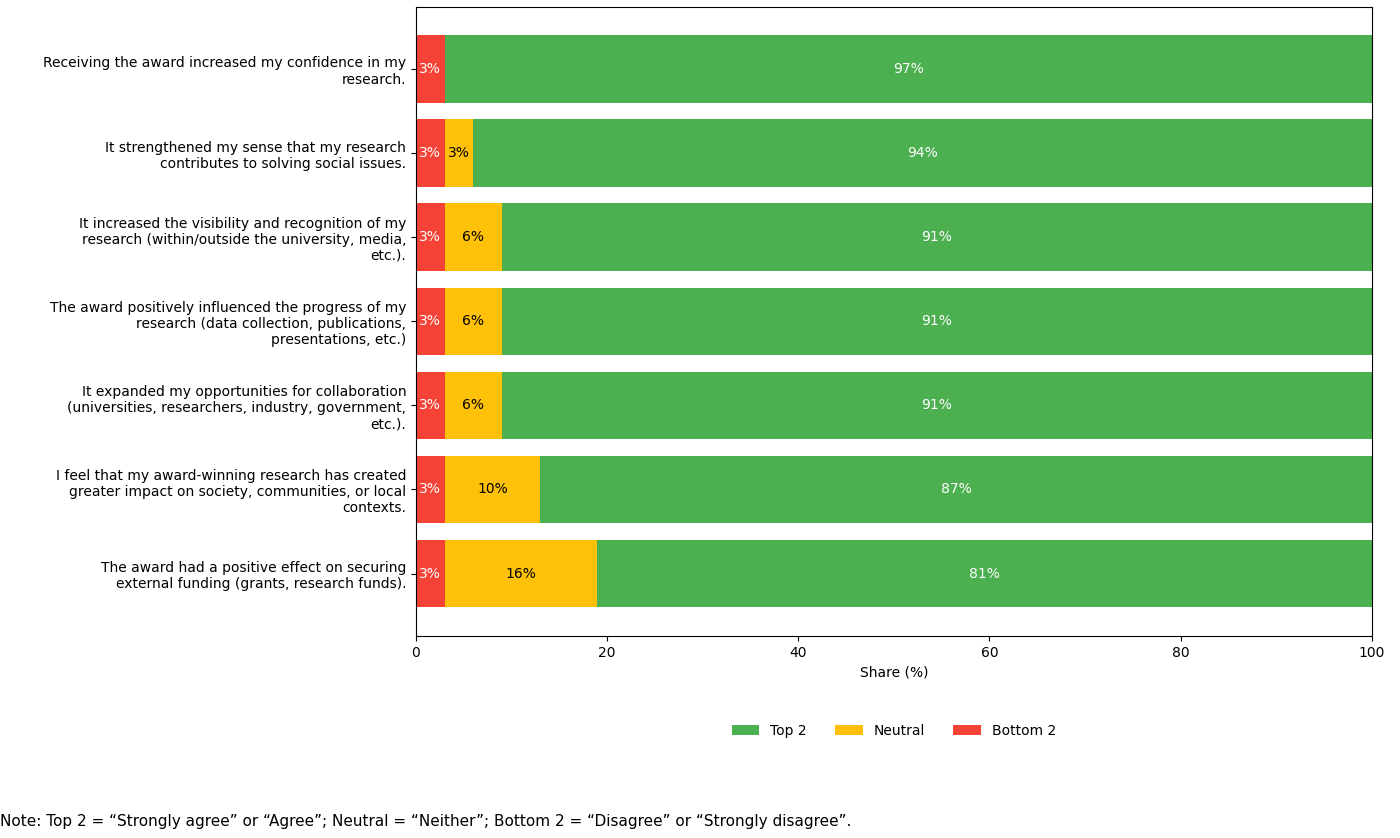
As shown in Figure 3, recipients reported wide‑ranging positive effects, including research progress, acquisition of external funding, opportunities for collaborative research, advancement of social implementation, and enhanced visibility both within universities and in media.
Top‑2 responses (“Strongly agree” + “Agree”) on a 5‑point scale ranged from 80–97%, indicating that receiving the Award significantly contributed to motivation and to strengthening research foundations.
At the same time, some neutral responses (“Neither agree nor disagree”) suggest that differences in research fields or institutional environments may influence perceptions.
Survey Results (Quantitative Evaluation)
Figure3: Impact of Receiving the Award (All items, Sorted by Top 2)
Figure3 View on another screen
Survey Results (Qualitative Analysis Based on Case Studies and Open‑Ended Responses)
Case 1: Expansion of Local Implementation (Community Impact)
Receiving the Award helped expand community‑level activities related to the research theme, generating social impact through knowledge transfer and resident participation.
Case 2: Industry Collaboration and Technology Transfer
Post‑award, cooperation with industry increased, leading to tangible progress in technology transfer.
Case 3: Acceleration of External Funding Acquisition
The credibility of the research increased following the award, facilitating applications for external funding and research grants.
Case 4: Researcher Motivation and Strengthened Outreach
The Award enhanced motivation and accelerated publication efforts, outreach activities, and initiatives aimed at social implementation and commercialization.
Survey Results (Qualitative Analysis Based on Improvement Areas, Expectations, and Open‑Ended Responses)
Respondents generally evaluated the application process positively, particularly regarding the clarity of information and the smoothness of submission procedures. However, the open-ended responses for future improvements highlighted expectations for enabling individual applications in addition to applications through affiliated institutions, strengthening information provision, and enhancing post-award support (such as networking among awardees and follow-up funding).
Main suggestions included:
- Allowing both university‑nominated and individual applications
- Holding pre‑application briefings and providing anonymized case collections
- Expanding alumni networks, researcher matching, and opportunities for research exchange
- Strengthening program visibility at both national and university levels
3-3. Program Improvements (Challenges and Responses)
Through a university office survey conducted in 2022, interviews during annual visits to target universities and research institutions, ongoing communication with awardees, and discussions within the selection committee, four structural challenges were identified.
3-3-1 Key Challenges (Identified as of FY2024)
- SDG Goal Selection Method: With two goals designated each year, ten goals were covered over the five‑year period. However, some of the remaining goals were not strongly connected to science and technology, making it difficult for certain researchers to apply. Universities also requested greater flexibility.
- Selection Criteria Volume and Operational Burden: The previous seven evaluation criteria were considered too numerous, making differentiated assessment difficult and increasing the burden on reviewers.
- Application Form Volume and Complexity: Feedback indicated a need for simplification due to overlapping sections and the heavy writing load required.
- Country-Level Gaps in Applications and Award Numbers: Applications and awards from Cambodia, Laos, and Myanmar remained lower than those from Indonesia, the Philippines, and Vietnam. For countries with fewer applications, the program has made efforts to highlight even small achievements and monitor trends.
3-3-2 System Revision (FY2025)
- Selection Criteria: Consolidated from seven items to four, clarifying evaluation priorities and enhancing consistency.
- SDG Goal Selection: Applicants now freely select one goal and one target, allowing for greater diversity in research fields.
- Application Form: Simplified by removing overlapping items and reorganizing sections in line with the new criteria.
These changes were aimed at clarifying the evaluation framework, reducing applicant burden, and encouraging broader participation. Their effectiveness will be assessed in the next review cycle.
4. Future Directions
Based on the first five years and the FY2025 system revisions, the following priorities will guide efforts toward sustainable operations and enhanced applicant support:
- Expanding and Updating Information Provision: Starting with the publication of the awardee list (FY2020–FY2024), continue building case information to support applications and research design.
- Addressing Country‑Level Gaps: Continue dialogue and provide detailed explanations for countries with fewer applications to encourage broader participation.
- Upholding Fair and Transparent Selection: Continue external expert involvement, documentation sharing, and standardized online operations.
- Further Improving Applicant Support: Regularly update FAQs, refine application forms, and provide necessary information to interested applicants.
- Responding to SDGs beyond 2030: Monitor international developments for post‑2030 frameworks and revise evaluation perspectives as needed.
- Responding to ASEAN Trends (Expansion of Eligible Countries): With Timor‑Leste’s formal admission to ASEAN in October 2025, include the country as eligible from FY2026. Maintain flexibility to adjust requirements and procedures in line with regional trends.
- Strengthening the Awardee Community: Explore possibilities for awardee‑led research meetings.
- Five‑Year Review Cycle: Evaluate the effectiveness of the system revisions and the overall operational validity in the next five‑year cycle.
Contact
The Hitachi Global Foundation
Office of The Hitachi Global Foundation Asia Innovation Award